Showing posts with label student engagement. Show all posts

Wednesday, May 14, 2014

A Beautiful Example


Hyman, S. C. (2014). Planning and creating a library learning commons. Teacher Librarian, 41(3), 16-21.

This is a beautiful article; I am fighting the urge to copy it verbatim for my Vision assignment. Shannon Hyman details her district’s process of building a LEED-Certified Elementary School and creating a Learning Commons with great deliberateness. Intentionality, beauty, literacy, and connection run through this process and presumably the space itself. Hyman writes that “planning a center of teaching and learning means restructuring existing notions about libraries as storage spaces and constructing a vision of the space as a scaffold to support both formal and informal learning experiences simultaneously.” (Hyman, 2014, p.16). She offers specific examples of seating choices, marine-grade fabrics, foldable tables; she also shows clearly how students use the space and how this use is purposeful, readily adaptable to different learning purposes, and aligned with the school’s goals. This purposeful alignment shows in her statement that planning followed the 

“AASL Standards for the 21st-century Learner in Action (2009) and our school's inaugural initiatives, which include the precepts that learning is cooperative, empowering, active, and meaningful. Our planning team knows intuitively that in order to maintain the integrity of this vision and create a culture of readers, we must tend to the space, the furnishings, the collection, and most of all the people. We make every decision based on three distinct priorities-people, flexibility, and durability-knowing that the core of our learning community requires a learning commons. Our LLC is not a storage place for books and equipment with limited accessibility. Students are greeted with a series of posters that remind them that in this space we think deeply, speak gently, read widely, and work hard.” (Hyman, 2014, p. 17)”

Hyman goes on to describe the power of collaboration and the primacy of literacy in an elementary school library; she posits the Learning Commons as the center of a story that radiates through the school and offers a beautiful quotation by Mem Fox about how literacy sharing is collaborative in nature.  Love of story and careful attention to children’s needs—as evidenced by clear planning and ergonomically designed gliders, tables, and stools—make this library one I’d love to see in person.  She clearly explains the multiple roles that the LLC plays, saying that though its design, “our LLC is a curious balance of two worlds: cozy, restful spaces for overly stimulated minds and roomy areas that activate wonder, the exchange of ideas, and exploration” (Hyman, 2014, p. 21). I highly recommend this article. 

Wednesday, May 7, 2014

Yatzee and biscotti: A visit to Southern California's board game cafe


Jolene Kemos

Gonzalez, S. (2014, May 1).  Yatzee and biscotti:  A visit to Southern California’s board game cafe [Web log post].  KCRW Which Way L.A. Retrieved from http://blogs.kcrw.com/whichwayla/2014/05/yahtzee-and-biscotti-a-visit-to-southern-californias-board-game-cafe

Descriptive Summary:
This article profiles a new cafe in Los Angeles. GameHaus houses over 700 board games that range from the traditional to the obscure.  The cafe and model for business responding directly to the needs and wants of the community.  They provide space, snacks, and games catalogued by theme.  As a means of introducing patrons to new games, they offer regular special events and tutorials. Further mention is made of the culture that is developing in which strangers are willing to play with each other, or support the learning of new games. Employees are tasked as "sherpas" to bring patrons into the full experience of the gaming options.

Evaluation:
It is very inspiring to see models of user service and participatory service in unexpected places. GameHaus models meeting the needs and desires of a community and employs its customers as creators of knowledge content and expertise.  This is a perfect analogy to the participatory culture we are trying to cultivate in LIBR 233.  

Sunday, May 4, 2014

Padlet-Collaboration Tool


http://padlet.com/
Grades: Grades 6-12

I found this free tool through a Common Sense Media review of the 10 best new applications for educators. (The review is here: http://www.graphite.org/website/padlet.) Anna Taylor and I are using it to collaborate for a project and I'm really inspired by its functionality.

Padlet lets you pin videos, text, links, images, anything that can be added to a board with a simple drag-and-drop system. It enables you to share ideas from many different mediums, including documents, class notes, and completed assignments, in one easy to access place. Since more than one person can contribute to a Padlet wall, its useful for teamwork and group project. I like one educator's suggestion that you can post a prompt, ask each student to contribute, and then once everyone has posted, you can change the setting so everyone's input can be seen.

Anna found this great Padlet mini-tutorial on YouTube which explains some of the features that are especially useful for teachers.


Tuesday, December 3, 2013

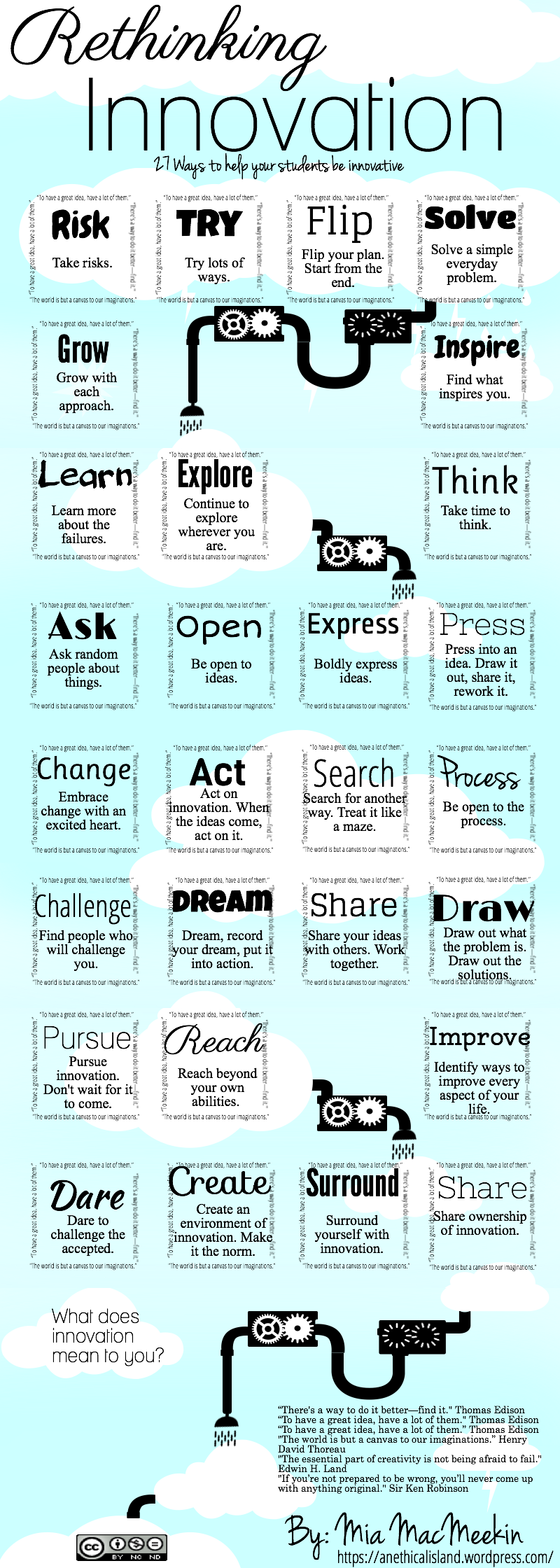
Rethinking Innovation - An Infographic from Mia MacMeekin


Rene Hohls
Mia is the master of the infographic - she can visually organize and illustrate a tremendous amount of information in some of the most well-crafted infographics available for use with teachers for PD or with students in the classroom. I love her creative and innovative focus - and she and I share a professional inspiration in Sir Ken Robinson who so succinctly puts our educational system into focus.
What do you think?

innovation       


And for those of you who have not met
Sir Ken Robinson.....

here is a brief introduction to his brilliant mind and some of his controversial ideas about education reform:

Thursday, October 24, 2013

'Personal learning environments' emerging as K-12 trend to watch

Lauren Frederick

Ash, K. (2013, May 22) 'Personal learning environments' focus on the individual, Education Week. Retrieved on October 22 from http://www.edweek.org/ew/articles/2013/05/22/32el-personallearning.h32.html

While I wasn't able to retrieve this whole article from the Education Week website without a subscription, this article links to the New Media Consortium's 2012 K-12 Horizon report which lists Personal Learning Environments (PLEs) as a trend to watch for 2013. There is a lot of information emphasizing the path toward implementing them in all K-12 schools. It is a process that aims to visualize and organize the influx of information and resources that students are confronted with daily.

PLEs focus on self-directed and group-based learning, designed around each user’s goals, with great capacity for flexibility and customization. Students help create their own path to learning. The conceptual basis for PLEs has shifted significantly in the last year,from online ePortfolios and browser based PLEs to a handful of applications being used on smartphones, tablets, etc. Many free tools are making it easy to support individuals social, professional and learning activities.
"While the concept of PLEs is still fairly fluid, it is clear that a PLE is not simply a technology but an approach or process that is individualized by design, and thus different from person to person." They enable students to determine the style and pace at which they learn while exposing them to technologies that they may not otherwise encounter in traditional classroom settings that will help prepare them for university and the workforce.

I would recommend reading the report, especially to help pull together your own PLE. If you have access to the subscription, I recommend reading the whole series that this article is part of, called 'Digital Curricula evolving.'

Sunday, October 20, 2013

Transforming the learning experience, without technology

Jessica King


Davis, J. (2013, October 15). How a radical new teaching method could unleash a generation of geniuses. Wired. Retrieved from http://www.wired.com/business/2013/10/free-thinkers/

     Davis recounts the experiences Sergio Juarez Correa, a teacher in Matamoros, Mexico, had in 2011 when he reinvented the way in which he taught. He drew his inspiration from the “emerging educational philosophies... that [apply] the logic of the digital age to classroom” and the ideas that Sugata Mitra developed after his experiments with supplying disadvantaged children with technology.  A majority of the article is spent on supplying the background information on those new ways of teaching and engaging students with technology. The focus of Correa’s teaching was very much in line with the ideas of inquiry-based teaching; he would engage the students with open-ended questions and let them work through the concepts until they supplied an answer. Although Correa drew inspiration from Sugata Mitra, he was not able to grant his students access to technology in the way he would have hoped. The school he worked in was very disadvantaged and technology classes occurred once a week and usually involved pictures of technology instead of actual technology. This article, though, speaks of the accomplishments that teachers and students are able to make even without the technology present. It reinstates the idea that bringing the technology to the students is not enough, we have to alter the way in which students are ‘taught’ by bringing them to the forefront of the process.

Saturday, October 19, 2013

Teaching Kids by Getting out of their way.

Nicole Myerscough

Davis, J.  (2013, October 15).  How a radical new teaching method could unleash a generation of geniuses. Wired, 21(11).  Retrieved from http://www.wired.com/business/2013/10/free-thinkers/all/

"That logic is inexorable: Access to a world of infinite information has changed how we communicate, process information, and think. Decentralized systems have proven to be more productive and agile than rigid, top-down ones."

This is a very informational article that not only not only exemplifies the success of elearning but how using recent trends in technology is beneficial and empowering for students no longer interested in their education. 
But, school that for many of the students in this article was viewed as a punishment, they learned to enjoy their learning the format in which it was given only needed to be changed.

The article also provides a timeline of alternative education, and the concept that our traditional educational design is in need of redesign goes back all the way Socrates, became more mainstream with the Montessori schools, and still we hold steadfast on a design proven several times to fall short of success. In the right environment, a student that was assumed as uninterested may then have an opportunity to  thrive.

Thursday, September 26, 2013

Play or Learning?


Jessica King

Crow, S. R. & Robins, J. (2012). Play in the library. Teacher Librarian, 39(5), 36-43.
             
Summary:
         Crow and Robbins (2012) address the decreasing amount of time that schools are giving over to “play” time for students by cutting down recesses and cutting out arts and music lessons. It is their argument that this is detrimental to children because “play is a way for children to make sense of the world they will inherit” (p. 36). The authors then discuss the way in which “play” can be used to engage and teach students and that the library is the perfect place to do this because of the vast amount of resources it has available. There are three ways to allow students to “play” in the library and take control of their learning: inquiry-based learning, storytelling, and questing. Inquiry-based learning is that chance for students to question and explore topics that interest them. Storytelling is reading and listening to stories as well as creating their own stories in their own formats. Questing focuses more on the navigation of the multitude of resources that are available and learning how to find the right resources. About half way through the authors do switch to the term "Learning Commons" when they are referring to the library and reference the book The New Learning Commons. The authors keep the focus on the library perspective and offer examples from activities schools have instigated. 

Wednesday, July 24, 2013

A Different Kind of 'Flipped' Learning: Students Teaching Students

McGuire, D. (2013, May 13). A different kind of 'flipped' learning: Students teaching students [Web log entry]. Retrieved from http://www.eclassroomnews.com/2013/05/31/a-different-kind-of-flipped-learning-students-teaching-students/

The author discusses how he integrates multiple technologies in his daily lessons as a fifth grade teacher.  In showing his students how to operate the technology, McGuire's students became so engaged that his "role is now more of a facilitator while [his] students collaborate, coach, and instruct each other."  As a result, student achievement has increased significantly. This personal account I peppered with examples of engaging and meaningful lessons.

7 Talks for Inspiring Transformed Education

Samimi-Moore, S. (2013, May 9). 7 talks for inspiring transformed education [Web log entry]. Retrieved from http://blog.ted.com/2013/05/09/7-talks-for-inspiring-transformed-curriculums/?utm_source=feedburner&utm_medium=feed&utm_campaign=Feed%3A+TEDBlog+%28TEDBlog%29

Compiled for Education Week 2013, this blog showcases seven TEDTalks that discuss innovative ways in which schools and curriculum are being transformed around the world.

Dan Meyer: Math class needs a makeover; March 2010 (11:39) - Meyer discusses why students in the US do not retain math processes, why that is detrimental to society as a whole, and what can be done to combat it.

Mae Jemison on teaching arts and sciences together; February 2002 (21:25) - Former US astronaut Jemison says that "The arts and sciences are avatars of human creativity."

Liz Coleman's call to reinvent liberal arts education; February 2009 (18:41) - Coleman postulates that traditional educational systems be transformed into cross-disciplinary, hands-on learning environments.

Shimon Schocken: The self-organizing computer course; June 2012 (16:26) - In his talk, Schocken discusses the power of self-learning. He, along with Noam Nisan, developed curriculum that later moved online and became the first MOOC. Schocken states, "Self-study, self-exploration, self-empowerment -- these are the virtues of a great education."

Geoff Mulgan: A short intro to the Studio School; July 2011(6:16) - To combat student drop-out rates and dissatisfaction of employers on employability of people coming out of school, the UK developed a school where 80% of the curriculum is taught through practical projects. Mulgan says that, "You work by learning, and you learn by working."

Tyler DeWitt: Hey science teachers -- make it fun; November 2012 (14:11) - DeWitt noticed that students in his science classroom were not understanding the material presented in the textbook. He found a way to bring the material to life by means of demonstrations and stories. Through this method, students are more apt to understand an retain the information.

Kiran Bir Sethi teaches kids to take charge; November 2009 (9:32) - Sethi, founder of a school in India, declares [I'm paraphrasing her here] that when learning is embedded in real world context -- when the boundaries between school and life are blurred -- children go through a journey of aware (see a change), enable (be changed), and empower (lead the change).

Online Resources for Engaging Every Student Every Day

Ormiston, M. (2013, June 11). Online resources for engaging every student every day {Web log entry]. Retrieved from http://smartblogs.com/education/2013/06/11/online-resources-for-engaging-every-student-every-day/

Students will not learn if they sit passively in class.  Students must be engaged and participating in meaningful activities.  The author of this article says that students should work actively with the curriculum not only inside of the classroom, but outside of the classroom as well.  Students should also collaborate with each other. The author mentions several tools throughout the article: PollEveywhere, Google Hangouts, and Edmodo -- just to name a few.